12 November 2026
How a GMT watch keeps two time zones at once
One hand jumps to wherever you've landed; a red one quietly keeps home time. Here's the handful of wheels underneath that make it work.
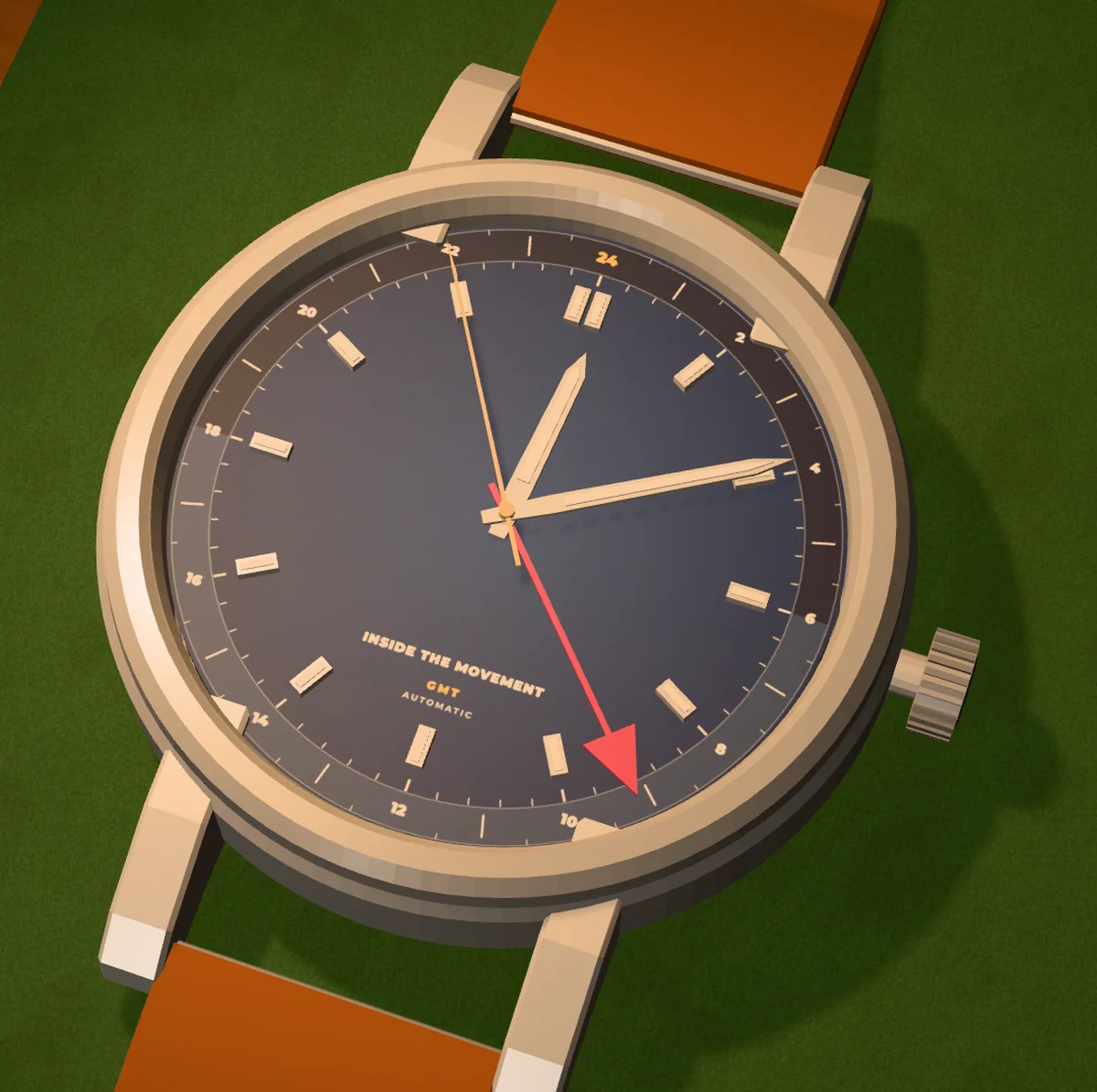
Fly six hours east and you have a choice: reset your watch and lose track of home, or leave it and do the sums in your head every time you check it. A GMT watch lets you have both. Our fourth reel built one on top of the channel’s base movement. This is the slower version, step by step, with the parts labelled.
Two hour hands, two jobs
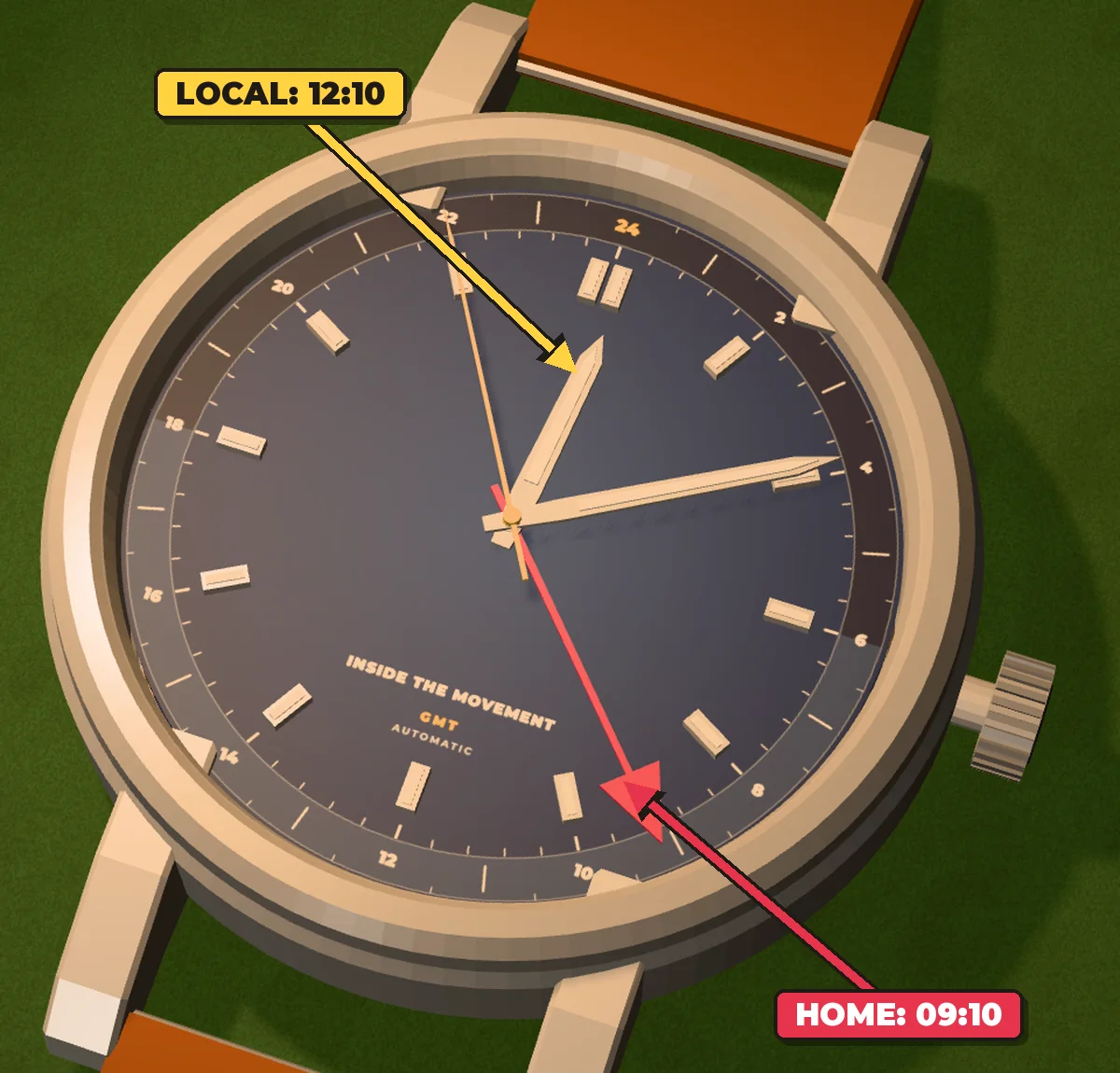
A GMT (from Greenwich Mean Time) has an extra hour hand, usually in a bright colour, that goes round once every 24 hours instead of every 12. Because it takes a whole day per lap, it never has to say whether it means morning or evening: 09:00 and 21:00 sit on opposite sides of the dial.
The trick is in how the two hour hands are driven. In our watch:
- the red hand is geared to the movement and never jumps, so it keeps home time;
- the ordinary hour hand can be moved on its own, one hour at a time, to show local time.
The minute hand is shared, because almost every time zone differs from the next by whole hours.
The red hand: a second wheel, half the speed
Under the dial of every mechanical watch sits a small set of gears called the motion works. The cannon pinion turns once an hour and carries the minute hand. It drives the minute wheel, which in turn drives the hour wheel, geared down to one turn every 12 hours.
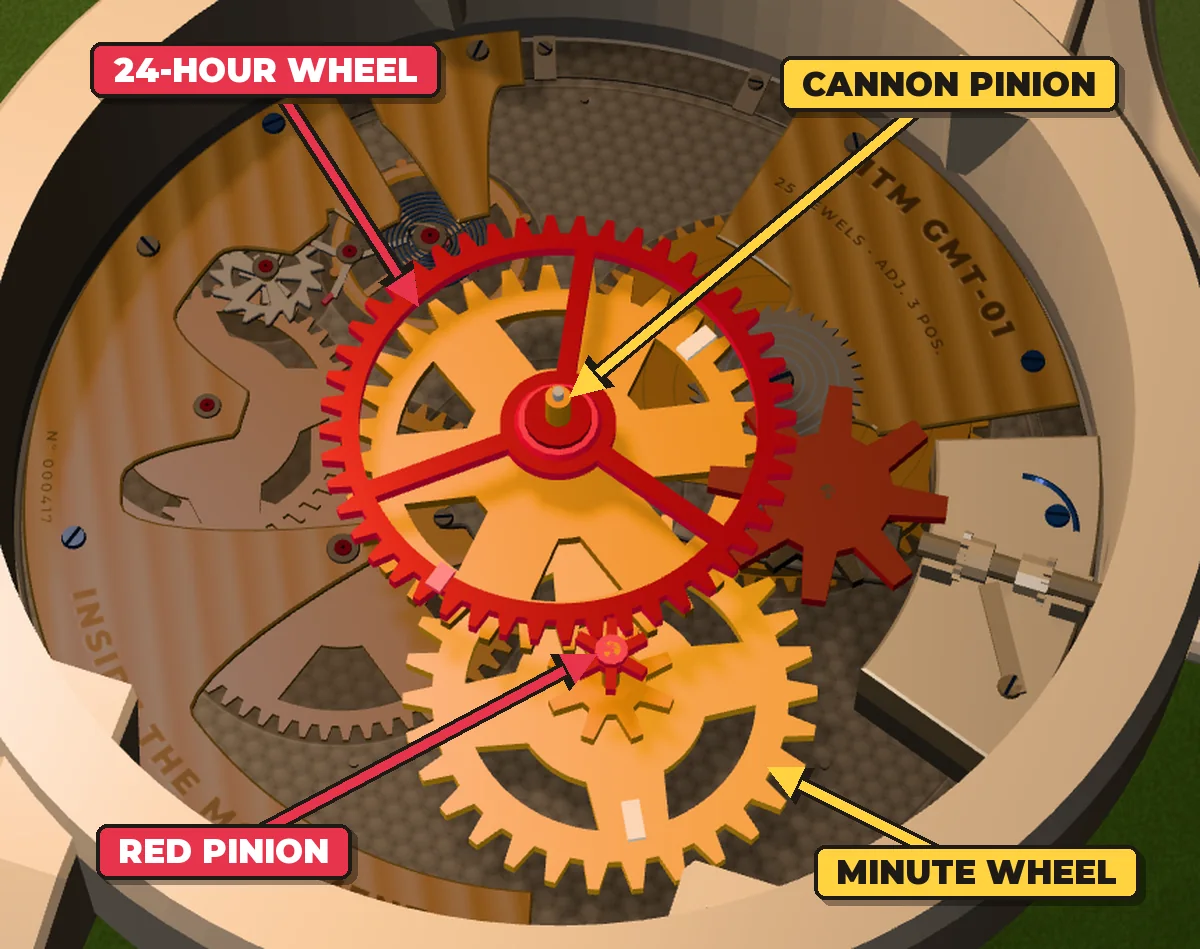
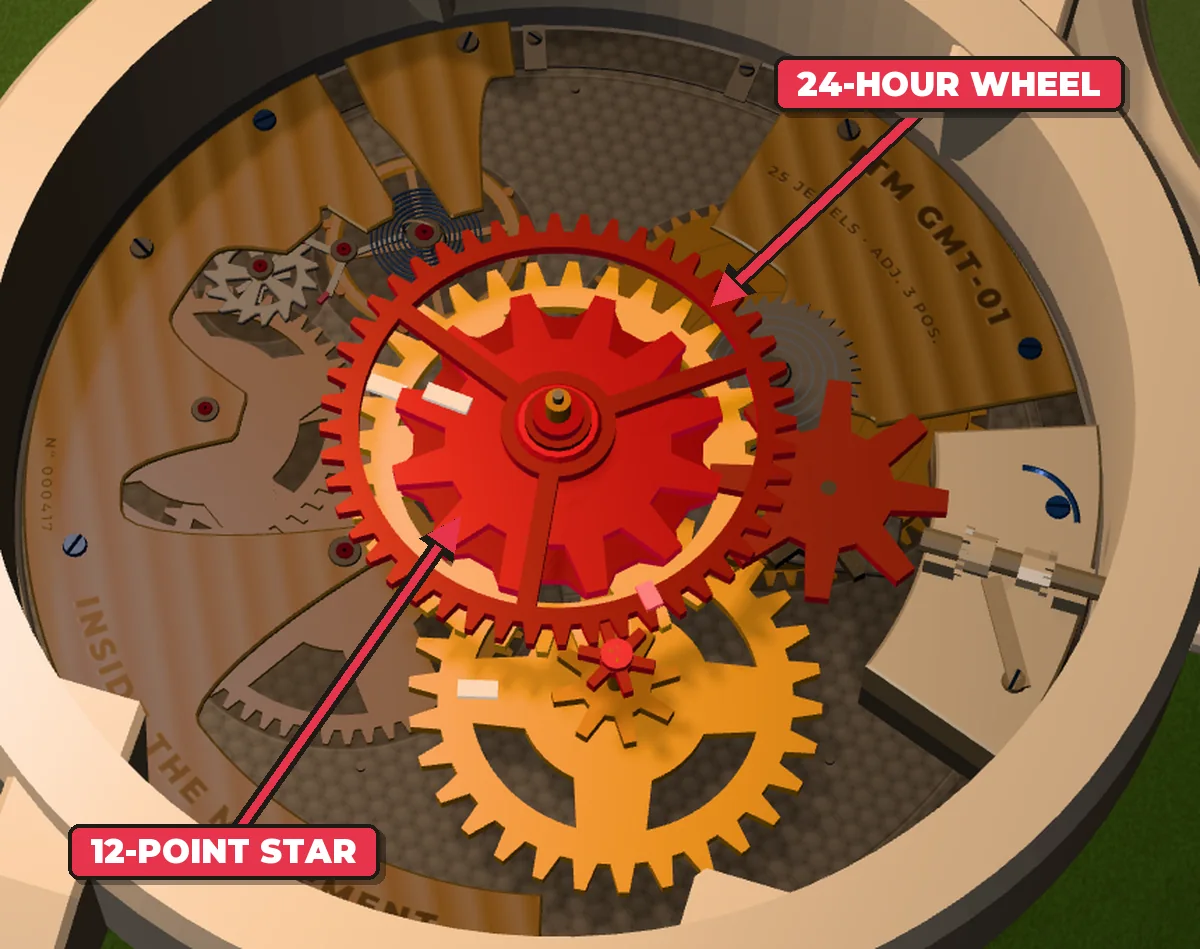
A GMT adds one more step. A tiny red pinion rides on the minute wheel’s arbor and turns with it. It meshes with a large 24-hour wheel that sits over the centre. The tooth counts are chosen so that the red wheel makes one turn while the hour wheel makes two: once a day. The red hand sits on that wheel.
In our model the numbers are real: a 10-tooth cannon pinion, a 30-tooth minute wheel, an 8-leaf pinion driving a 32-tooth hour wheel (one turn in 12 hours), and a 6-leaf red pinion driving a 48-tooth red wheel (one turn in 24). Pause the reel and the teeth genuinely mesh.
The local hour hand: a star and a click
The ordinary hour hand needs to do something unusual: move by itself, without dragging the minutes or the red hand along. So it doesn’t sit directly on the hour wheel.
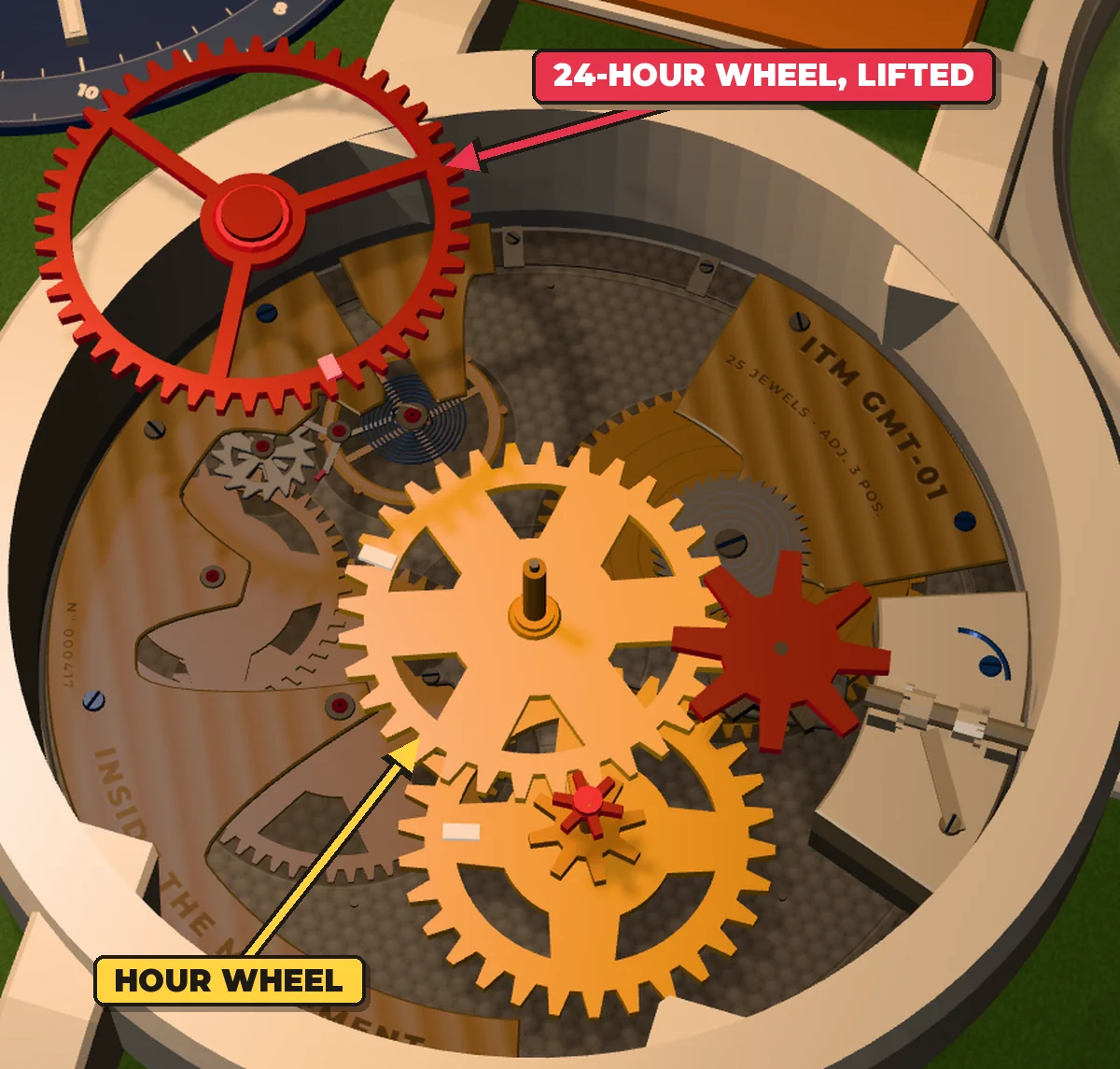
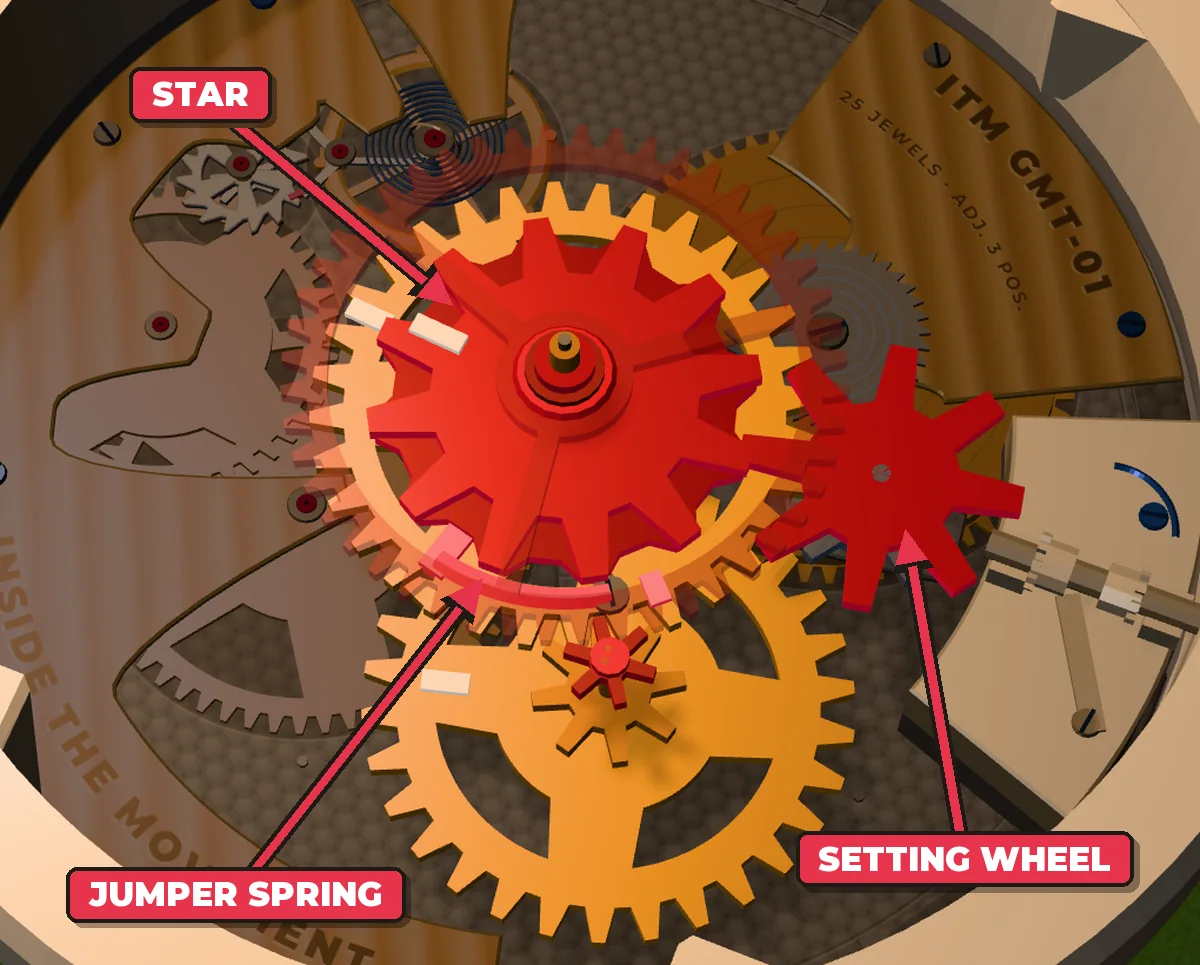
Instead it sits on a twelve-point star that rides on the hour wheel’s pipe. Twelve points means each point is exactly one hour (30 degrees) of the dial.
A sprung jumper is fixed to the hour wheel, its nose pressed into a valley between two points of the star. Most of the time this locks the star to the hour wheel, so the hour hand moves round normally with everything else.
Setting local time
Pull the crown out one click and turn it. A setting wheel at three o’clock meshes with the star and pushes it round. The jumper’s nose rides up over a point and snaps into the next valley: click, one hour. Turn again: another hour.
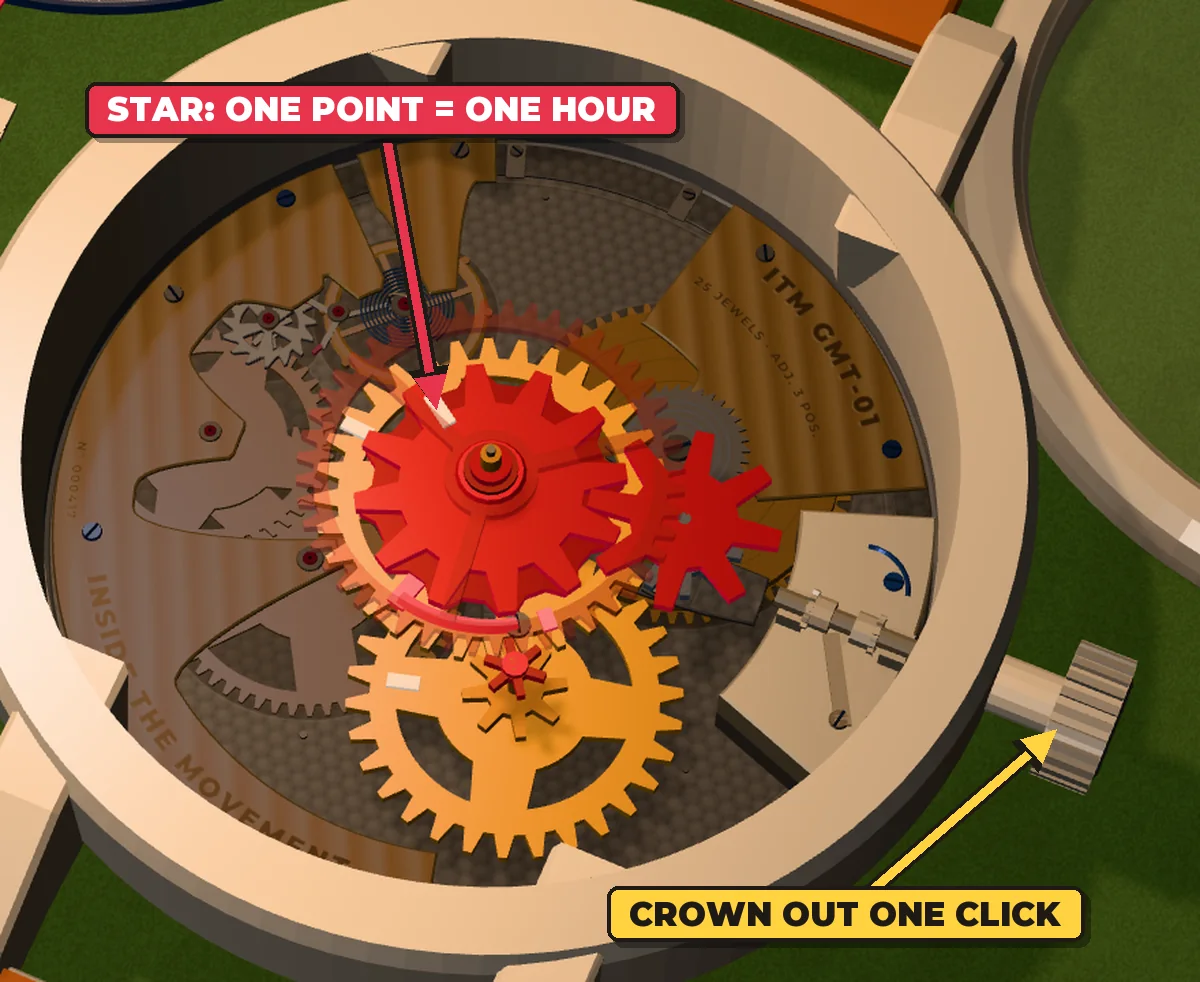
Only the star and the hour hand move. The minute train, the hour wheel and the red 24-hour wheel stay exactly where they were, so home time is untouched. Pull the crown out a second click and it drives the minute wheel instead, moving every hand together for ordinary time-setting.
Reading it
Push the crown home and the watch shows two times at once:
- Local: the hour and minute hands, read as normal.
- Home: the red hand on the 24-hour scale, with the same minutes.
That’s the whole mechanism: one extra pinion and wheel for home time, and a star, a jumper and a setting wheel for local. Watchmakers call this style, where the local hour hand is the one that jumps, a “flyer” GMT. It’s built for travellers who want to change local time quickly when they land.
Watch the reel to see it built part by part.